

Planning a wholesale, OEM or project order?
Talk to YAZO sales →Direct Answer: Start With Load, Runtime and Market
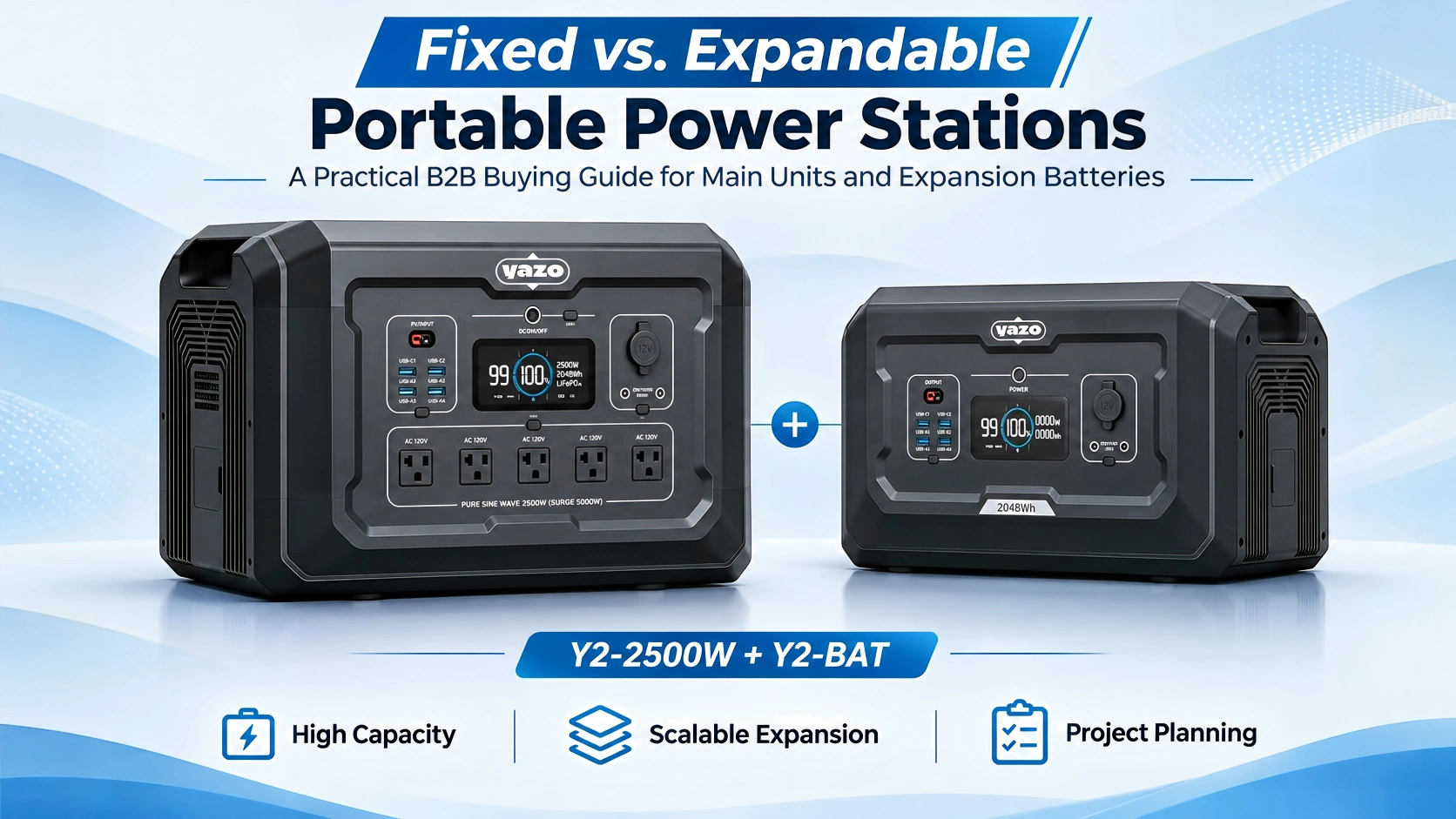
For B2B purchasing, choose a portable power station by defining five inputs: continuous load, starting load, required runtime, battery energy in Wh, and destination-market electrical requirements. Then verify charging options and compare documented model specifications before requesting a recommendation.
This guide helps importers, distributors, private-label brands and project buyers turn an application into a clear sourcing brief. A higher headline wattage alone does not establish the right fit.
Key takeaways
- W and Wh answer different questions: which devices can run, and for how long.
- Check startup demand separately from continuous output.
- Confirm charging limits, regional versions and approved battery compatibility.
- Send a load list and order requirements for a useful B2B quotation.
Use these checks to compare the YAZO Portable Power Stations range by application and specification.
| Buyer input | Specification to verify | Risk to avoid |
|---|---|---|
| Devices running together | Continuous AC/DC output and per-port limits | Adding devices beyond the relevant output limit |
| Motor or compressor startup | Surge capability, duration and load compatibility | Treating peak watts as continuous output |
| Operating hours and energy demand | Usable Wh under the intended conditions | Assuming rated capacity guarantees runtime |
| Destination country | Voltage, frequency, socket and documentation | Ordering the wrong regional version |
Build a Real Load List
List the equipment your customer will actually use. Record the number of devices, power demand, operating hours and which loads run together. Use nameplates, equipment manuals or measured data; generic appliance estimates may miss the real operating pattern.
Compressors and motors can have a starting demand that differs from their running demand. For cycling equipment, separate maximum simultaneous power from energy used over a representative period.

Match Continuous and Surge Output
Continuous output is the power available under the manufacturer's stated operating conditions. Surge output addresses a temporary demand, such as equipment starting. Verify the permitted duration and load type, rather than comparing only a "max W" claim.
| Procurement question | Ask the supplier to verify | Common mistake |
|---|---|---|
| Can all planned loads run together? | Rated output, per-port limits and shared-output restrictions | Checking socket count without checking total power |
| Will the largest device start? | Starting demand, surge duration and a relevant load test | Using a peak wattage as a continuous rating |
| Does the equipment need uninterrupted supply? | Transfer behavior and compatibility with the actual equipment | Assuming every power station operates as a UPS |
For an outdoor retail assortment, compare Camping Power Stations after defining the intended loads and transport requirements.
Estimate Energy Capacity and Runtime
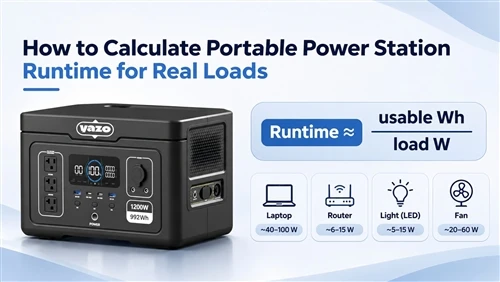
Watts describe power demand. Watt-hours describe energy. Add each device's energy use across the required operating period, including quantity and duty cycle where relevant.
Energy demand (Wh) = sum of load power (W) × operating time (h)
Estimated runtime (h) ≈ usable energy at the output (Wh) ÷ average load (W)
A hypothetical constant 100 W load operating for 3 hours needs 300 Wh at the load.
This is an energy-demand example, not a YAZO model runtime claim. It does not mean a 300 Wh rated battery will deliver three hours of AC runtime.
Actual usable energy depends on conversion losses, system consumption, temperature, battery condition and the load profile. Do not apply one fixed efficiency percentage to every model. Request a runtime estimate or test record that states the load, output type and test conditions.
Measurement background: the U.S. Department of Energy's guide to measuring standby power explains calculating average power from energy measured over time for fluctuating low-power loads. Model runtime still requires its own verification.
Check Battery Chemistry and Expansion
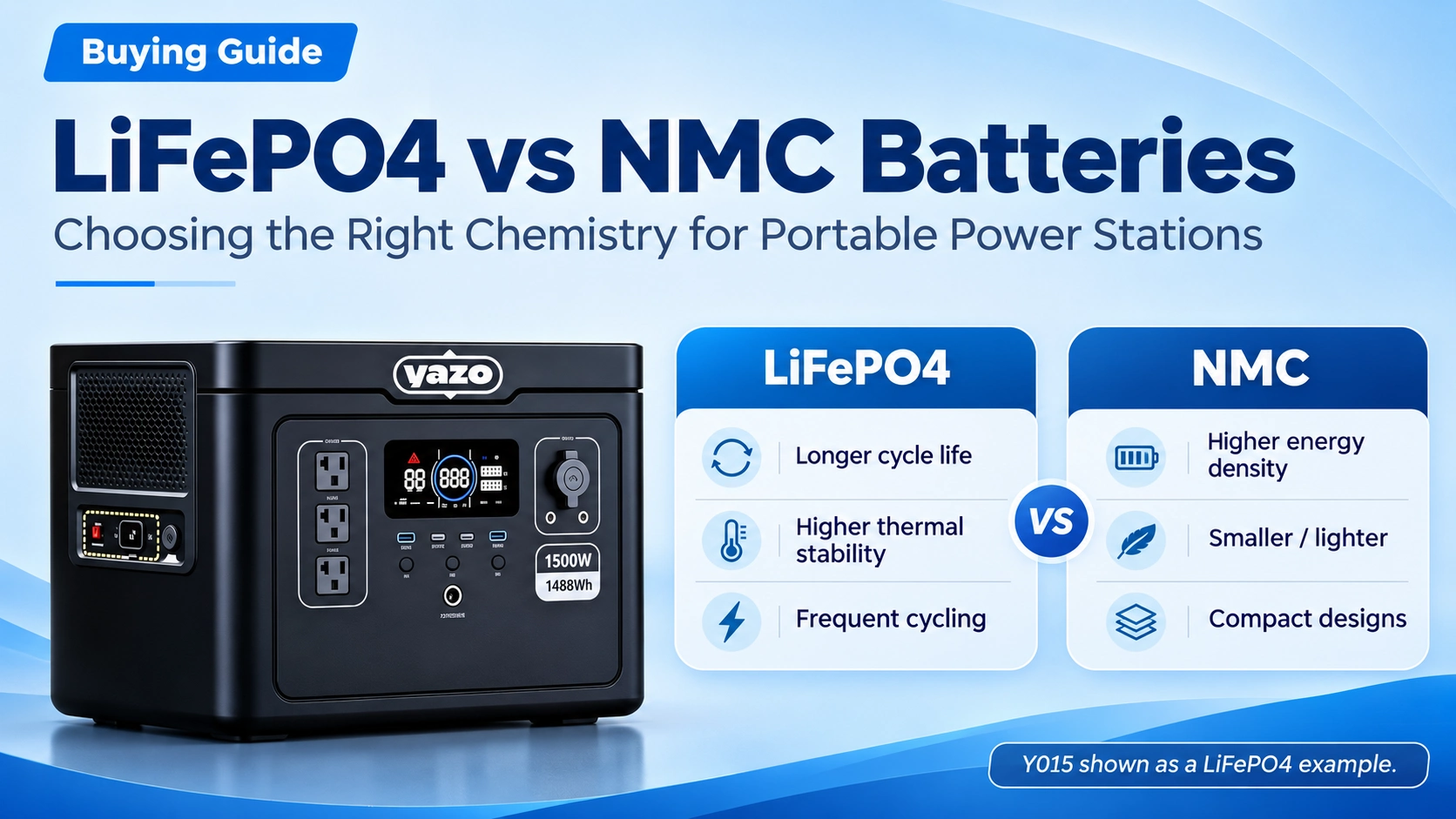
Confirm the chemistry and battery specification for the exact model and regional version. When comparing cycle-life claims, ask about the test conditions and remaining-capacity criterion. A chemistry label alone does not establish complete-system performance or service life.
For a fixed-capacity order
Review usable energy, weight, recharge planning, expected operating profile and warranty terms against the customer's daily requirements.
For an expandable system
Verify the approved battery model, expansion limit, cables, charging arrangement, version compatibility and warranty scope in writing.
Extra battery capacity does not automatically increase rated AC output. Confirm both energy and output limits for the complete configuration. For recurring outage requirements, continue with Home Backup Power Stations.
Verify Charging and Solar Input
Charging affects how quickly the system can return to service. Compare each supported input path separately and specify the accessories needed for the actual installation or sales bundle.
| Charging path | Specifications to confirm | Buyer verification question |
|---|---|---|
| AC | Accepted voltage/frequency, input power, cable and temperature conditions | Which regional cable and recharge conditions apply to this version? |
| Solar | Input voltage window, current/power limits, connector, polarity and panel configuration | Has the proposed array's open-circuit voltage and current been checked? |
| Vehicle | Supported vehicle voltage, current limit, socket and required charging cable | Is vehicle charging supported, and what accessories are included? |
For solar bundles, confirm the proposed panel arrangement against the power station's model-specific input limits, including open-circuit voltage under the expected temperature conditions. Matching the advertised panel wattage alone is insufficient. Charging time also depends on the source and operating conditions.
Confirm Regional Voltage, Frequency and Socket
Define the destination market before finalizing the order. Similar product names can cover different AC configurations, and the plug shape alone does not establish electrical compatibility.
- Electrical version: AC voltage, frequency, socket format and any per-port limits.
- Accessories: charging cables, adapters and the agreed packing list.
- Brand presentation: labels, manuals, language and packaging scope.
- Documentation: applicable regulatory and transport documents for the exact model, battery and destination.
Record these requirements in the quotation and order confirmation. Ask for relevant documents and model coverage; do not assume one version or certificate covers every market.
Application-to-Product Direction
The same selection method applies across applications, but the buying priorities change. Use the matrix below to identify the relevant category, then verify individual products against your load list.

Application illustrations from the YAZO website. Confirm the model and electrical configuration for your project.
| Camping & RV | Home backup essentials | Industrial / remote worksites |
|---|---|---|
| Load profile Mobile equipment, lighting, cooling and occasional higher-power devices |
Load profile Selected essential appliances and communication equipment |
Load profile Tools, temporary equipment and variable operating schedules |
| Buying focus Transport weight, daily energy, useful ports and recharge opportunities |
Buying focus Starting demand, backup duration, expansion and transfer requirements |
Buying focus Starting loads, duty cycle, environment, handling and recharge logistics |
| Evidence to request Weight, interface list, charging specifications and load compatibility |
Evidence to request Regional output, runtime conditions and approved expansion configuration |
Evidence to request Relevant load testing, operating limits and any claimed protection rating |
| Camping Power Stations → | Home Backup Power Stations → | Industrial Power Stations → |
B2B RFQ Checklist + FAQ
A useful RFQ explains what the equipment must do and how the order will be supplied. Include the following core fields, then add charging, interface, packaging and documentation requirements where relevant.
Six inputs for a better product recommendation
- 01 · APPLICATIONUse case and operating environment
- 02 · LOADContinuous and starting demand
- 03 · RUNTIMEHours and usage pattern
- 04 · MARKETCountry and electrical version
- 05 · QUANTITYSample, pilot or expected order volume
- 06 · OEM SCOPEBranding, packaging and documents